

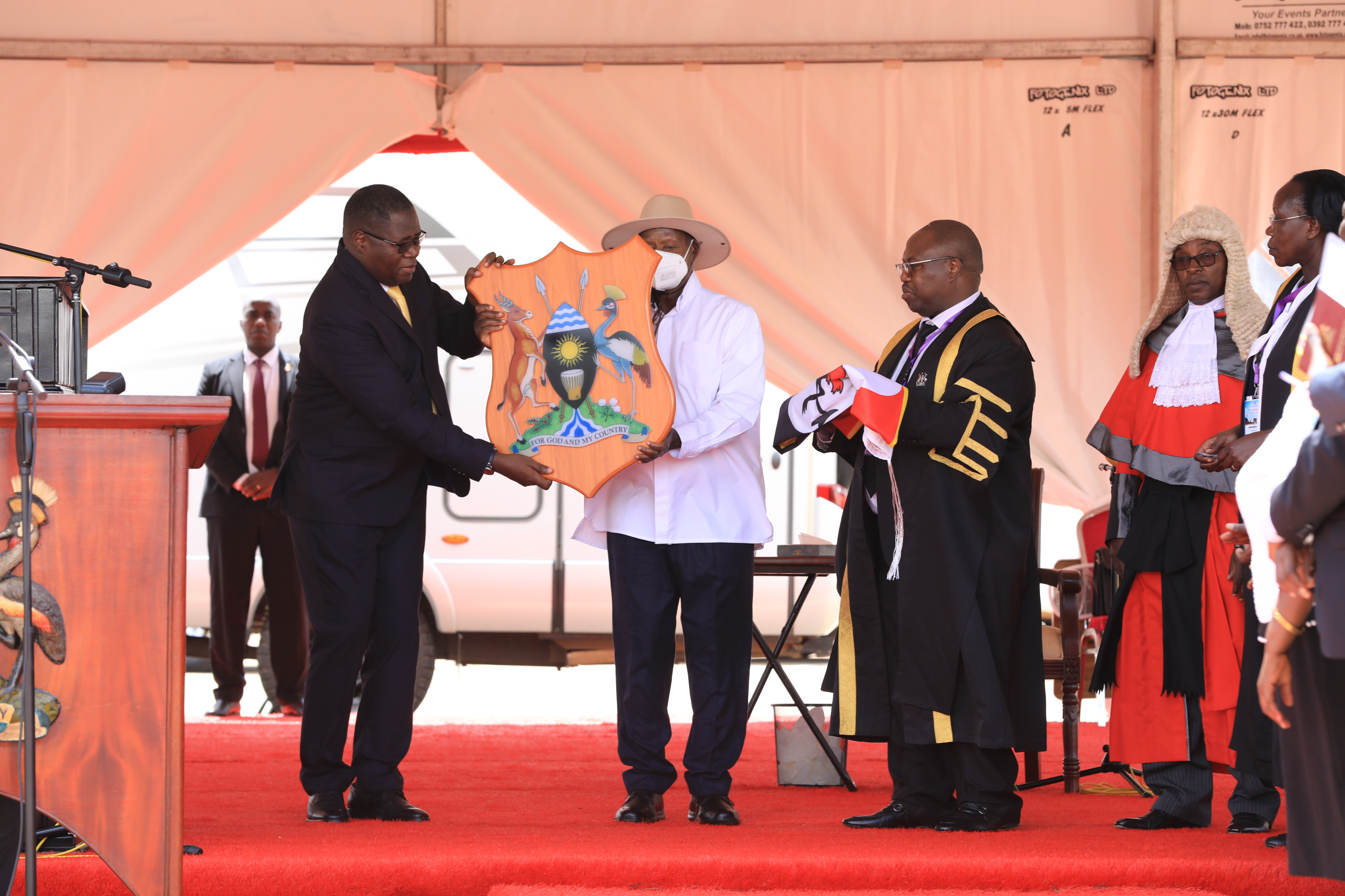
Uganda got a new Parliament today. It also got a reminder of something less ceremonial but equally telling: that in moments of genuine national significance, the competition for public attention among broadcasters is not really a competition at all.
That is not a comfortable thing to write. But the evidence of Monday’s inaugural sitting of the 12th Parliament makes it difficult to argue otherwise.
What Actually Happened
The day’s programme was constitutional and precise. The 12th Parliament convened at 10:00 AM under the presiding gaze of the Chief Justice. Nominations were taken. Votes were cast. Jacob Marksons Oboth-Oboth was elected Speaker with 441 votes, against Paul Mwiru’s 60 and Norbert Mao’s 15. Thomas Tayebwa followed as Deputy Speaker with 457 votes, dwarfing the combined tallies of his two opponents.
The President oversaw the administration of oaths, handover of instruments of power, addressed the House, and the sitting adjourned.
Every major broadcaster in Uganda — NTV, Spark TV, Bukedde TV, and NBS TV among them — carried the proceedings live. On the narrow question of access, there was no distinction. Parliament’s doors were open. The cameras were in.
The distinction, and it matters, emerged in what happened around the broadcast.
The Volume Question
Uganda’s political conversation on social media does not live on every platform equally. It concentrates — on X/Twitter in particular — around a relatively small number of accounts that carry disproportionate weight.
NBS TV’s presence on that platform, with over four million followers, means that its real-time coverage of today’s proceedings did not just reach television viewers. It shaped the terms on which much of the online discourse about the day’s events was conducted.
The result graphics, the tally breakdowns, the procedural explainers — these moved across WhatsApp groups and timelines in ways that extended the reach of the broadcast far beyond those who watched it.
Other broadcasters have social media presences. The gap in scale is, however, real and measurable. It is not a gap born of today. It has been built, year over year, through consistent investment in political coverage as a core editorial identity rather than an election-season obligation.
The Familiarity Problem
Parliamentary procedure is not intuitive. The reading of Rule 5 of the Rules of Procedure, the role of the Chief Justice in presiding, the constitutional basis for the oath under Article 82(10) — these are details that mean something to lawyers and political scientists and very little to the majority of viewers watching live.
The broadcaster that can contextualise them in real time, without slowing the coverage down or talking over the ceremony, has a material advantage in retaining and informing its audience.
This is where the accumulated investment in political journalism shows its value most clearly. Familiarity with parliamentary process is not improvised on the day. It is the product of years of covering committee sittings, budget debates, and constitutional moments that attract smaller audiences but build institutional knowledge.
NBS TV has been doing this since 2008. That history does not guarantee superior coverage on any given day, but it creates the conditions for it.
What the Results Actually Mean
The vote tallies themselves are worth examining not just as outcomes but as the kind of data that tests a broadcaster’s analytical capacity in real time. Oboth’s 441 votes in a house where NRM holds a commanding majority was not a surprise.
But the scale of the opposition candidates’ losses — Mwiru’s 60 votes representing NUP’s parliamentary strength, Mao’s 15 reflecting DP’s diminished footprint — tells a more nuanced story about the current balance of political forces in Uganda.
A broadcaster covering a parliamentary inauguration as a ceremony will report the winner. One covering it as a political event will ask what the margins reveal.
Whether any broadcaster fully rose to that challenge today is a question best answered by those who watched the full coverage across all channels. What is observable from the outside is that the infrastructure for that kind of analysis — the experience, the institutional relationships, the social media reach to amplify it — is not evenly distributed across Uganda’s broadcast landscape.
The Honest Caveat
Reach is not the same as quality. A large audience inherited from years of political coverage is not a guarantee that today’s coverage was the most rigorous, the most balanced, or the most illuminating on offer.
Uganda’s broadcasters are not a monolith. Individual journalists across multiple stations brought real knowledge and genuine craft to today’s proceedings. Any sweeping claim about one broadcaster’s superiority would require a granular, hour-by-hour comparison that this analysis has not conducted.
What this analysis can say, based on observable evidence, is this: when Uganda holds a constitutional moment of genuine national weight, the broadcaster that has treated political journalism as its defining identity — not its occasional guest — starts the day with structural advantages that are very difficult for competitors to close in real time.
Today was that kind of day. The 12th Parliament has its Speaker and Deputy Speaker. Uganda’s media landscape, for all its energy and plurality, continues to concentrate its political authority in familiar places.